
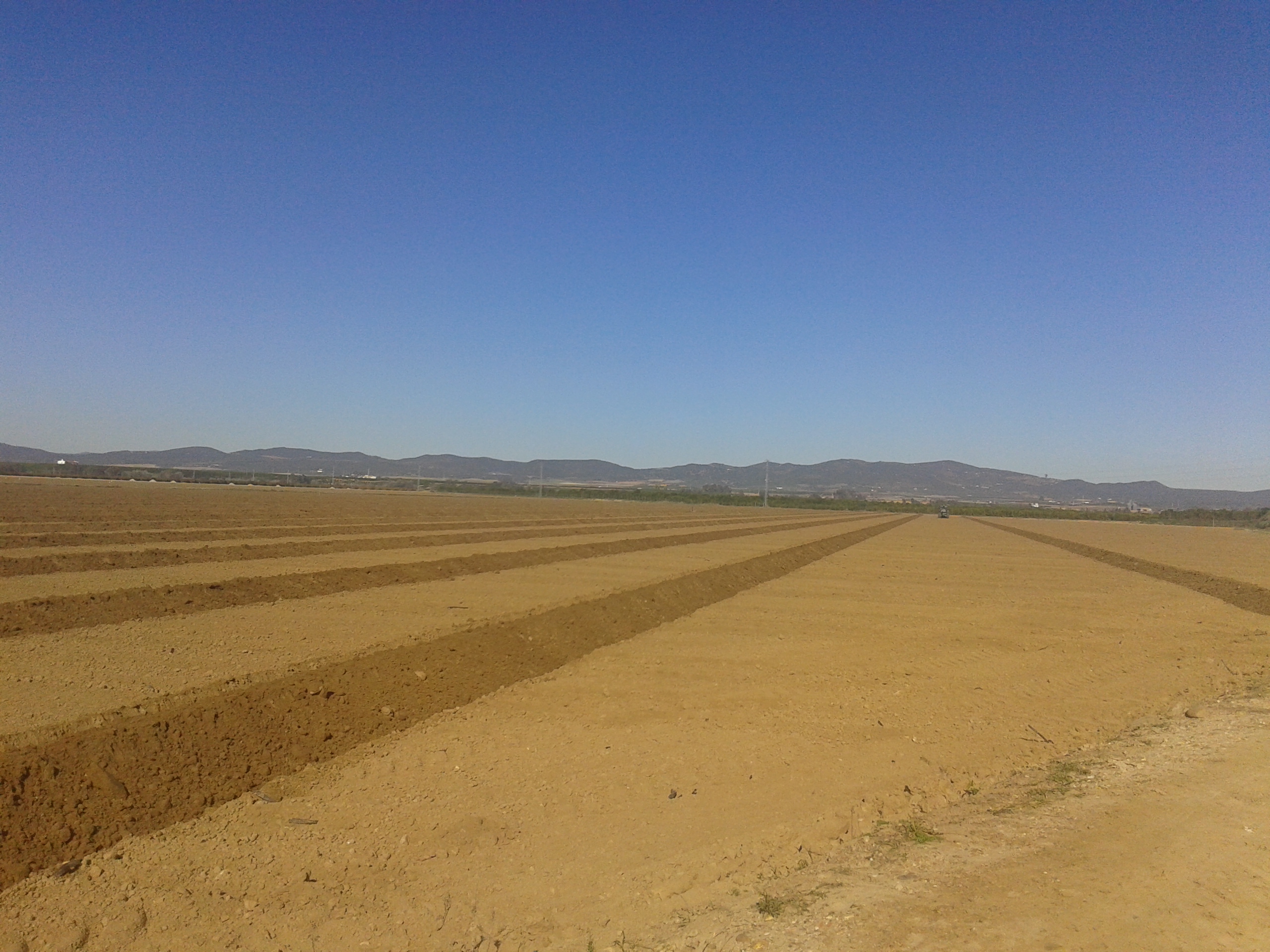
- The Community of Irrigators of the Genil Left Bank, in Palma del Río (Córdoba), today hosted the ‘Energy Day’, held within the framework of the REDAWN Project, a European initiative to promote efficiency in water networks, and organized by Feragua and WATEF (Water Efficiency NetWork, University of Bath in the UK), and which has served for the start of the pilot plant in Spain of the project, located in the Cortijo Calonge estate.
This meeting was attended by almost a hundred professionals and technicians from Spain, the United Kingdom, France, Northern Ireland, Ireland, Portugal and Italy, the countries involved in REDAWN, who attended several conferences and visited the pilot plant in Spain of the project, located in the farm Cortijo Calonge, which has the objective of evaluating the economic, social and environmental impact of mini-hydraulic energy in irrigation networks to reduce energy dependence.
The day was closed by Joaquín Páez Landa, president of the Guadalquivir Hydrographic Confederation; Manuel Gómez Galera, director of Agricultural and Livestock Production of the Ministry of Agriculture, Livestock, Fisheries and Sustainable Development; Jorge Juan Jiménez Luna, Managing Director of the Andalusian Energy Agency; José Antonio Ruiz Almenara, Mayor of Palma del Río; and Antonio Miguel Enamorado Aguilar, mayor of Lora del Río.
REDAWN is a three-year European innovation project that studies how to improve energy efficiency in water distribution networks in the Atlantic area through innovative technology based on the use of microturbines and inverse pumps. Endowed with a budget of 2.9 million euros, co-financed by FEDER funds through the Interreg Atlantic Area program. Its partners are the Spanish: FERAGUA, Asturian Energy Foundation (FAEN) and the University of Córdoba; from the United Kingdom: WATEF, Action Renewables and Nothern Ireland Water; of Portugal: IST Technician Lisbon, Hidropower, Renova, EDA Renovaveis, Electricidade de Madeira and Portuguese Water Partnership; from France, Service Public de l’eau; of Ireland: Trinity College Dublin and of Italy: Universitá degli Studi di Napoli Federico II. Through this project the possibilities of mini-hydraulic energy will be evaluated in the water networks of the Atlantic area, including supply networks, industry networks and irrigation networks. To do this, it will have three pilot plants where mini-hydroelectric power generators with medium powers will be installed in the environment of 10 kilowatts.
According to Pedro Parias, general secretary of Feragua, 3% of global energy consumption is associated with the production, distribution and treatment of water, “sector that is the fourth one that consumes the most energy and contributes greatly to the CO2 emission. ” To the environmental impact, water treatment must be added the economic cost, “since up to 80% of the cost of water for water supply is associated with the energy required for its collection, treatment and distribution and in the case of irrigation, it represents average 30% of the farmer’s budget and in some cases exceeding 50% “.
Likewise, localized irrigation, which already represents 50% of the irrigated area in Spain and 75% in Andalusia, manages water more efficiently but consumes more energy, having doubled its electricity costs since 2008, and ascending in Andalusia the electric bill of irrigation to about 180 million Euros. These data, together with the forecast of 33% growth in the global population by 2050 and more than 50% of the energy demand (above food or water), it is necessary to promote this type of hydroelectric energy recovery technology in water networks, which in the case of the Cortijo Calonge farm pilot plant will contribute to recovering “around 12 Mwh and generating an environmental saving of more than 9.5 tons of CO2”.
Together with Feragua, responsible for the dissemination of the project in the field of irrigation, the Spanish partners of the project are the Asturian Energy Foundation (FAEN), which will provide the investment in the pilot plant, and the University of Córdoba, which will define the technical requirements and will develop field research, working in coordination with Trinity College Dublin. It will be, adds Pedro Parias, a mini-hydraulic energy generation plant for irrigation “completely pioneer in Europe”, whose tender and execution will turn Cordoba, Andalusia and Spain “into the epicenter of a major European innovation project to promote energy saving and improve the environmental impact of irrigation. ”
During the Energy Day, in addition to the general secretary of Feragua, Miguel Crespo Chacón (Trinity College Dublin), Juan Antonio Rodríguez Díaz and Jorge García Morillo (University of Córdoba) also participated, who made the presentation of the pilot plant; and Sara Robles Fernández, from the Department of Energy Infrastructure and Renewable Installations of the Andalusian Energy Agency, who gave a presentation on the situation of renewable energy in Andalusia.